
Chaffee County Arrest Records and Court Charges
Chaffee County arrest records and court charges sit with different custodians. An arrest record is tied to law enforcement and can include the agency context, report, citation, custody confirmation, and bond status. The Chaffee County Sheriff's Office and its Records Division handle sheriff law-enforcement records, including reports, local criminal-history records, sex-offender registration records, concealed handgun permits, civil papers, and case files prepared for prosecution.
Court charges after arrest begin when the prosecutor files formal allegations with the court. The 11th Judicial District Attorney prosecutes criminal matters for Chaffee County, and charges become part of the Chaffee Combined Court case when filed. The full case file and final outcome are criminal court records. Custody and bond status may be checked through jail channels, and the full criminal case file is covered separately in Chaffee County criminal court records.
The assigned image from the Chaffee County Sheriff's Records Division shows the local records office tied to arrest reports and law-enforcement records.
Sheriff records support the arrest side, while the court clerk and prosecutor filing explain court charges after arrest.
Chaffee County arrest records and court charge records also split by agency. The Sheriff's Records Division can handle sheriff reports and some older Salida Police records, while newer Salida Police reports and Buena Vista Police records may require direct city contact. Once a prosecutor files a complaint or information, the charge record belongs in the court file. That sequence is why an arrest report, a filed charge, and a final conviction should be checked as separate records.
Find Chaffee County Arrest Records
The research did not locate a public Chaffee County mugshot or booking database on the official sheriff site. The jail page says staff will only confirm that they have the inmate and the inmate's bond status. For the arrest side, use the Sheriff's Office non-emergency line, the Sheriff's Records Division, or the police report process. For the court charge side, use the Colorado Judicial Branch docket search and the court record/document request form after the case is filed.
- For custody or bond status, contact the Chaffee County Sheriff's Office or jail channel identified in the research.
- For police reports or local sheriff criminal-history records, contact Sheriff's Records at 719-539-2814 or records@chaffeesheriff.org.
- For filed court charges, search the Colorado docket by Chaffee County, party name, case number, or attorney.
- Request the complaint, information, ticket, disposition, sentence order, or ROA through the court record/document request form.
- Use CBI Internet Criminal History Check for statewide Colorado name-based criminal-history access.
The official police reports page in the assigned image comes from Chaffee County Sheriff police reports and fees.
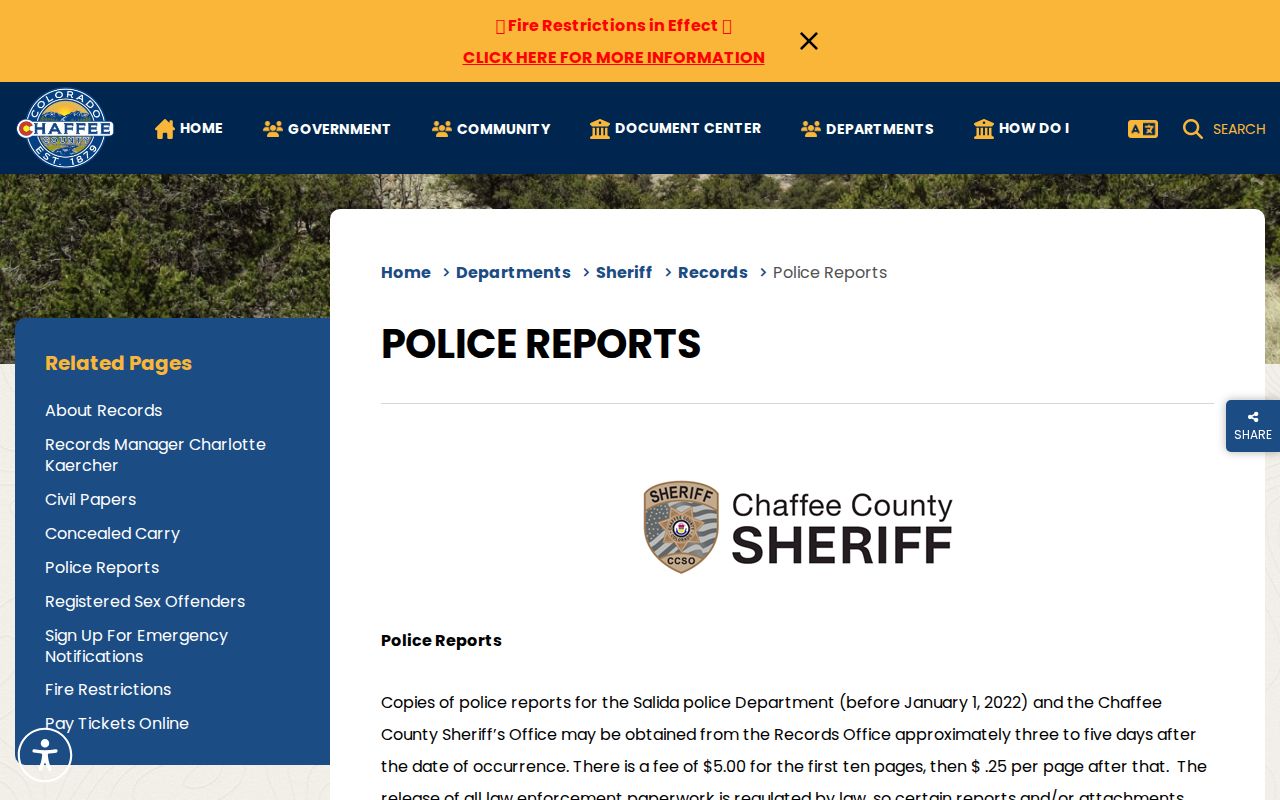
Police report access is part of the arrest-record path, but filed court charges are checked through court records after prosecution begins.
Charges After Arrest in Chaffee County
After an arrest, the law-enforcement report does not by itself decide the final court charges. The prosecutor reviews the case file and decides what to file. A charge record is narrower than the full criminal case file. It identifies the alleged offense, statute or case number, charging document, severity, and current status when available. One arrest can lead to no filed charge, one charge, or several separate charges.
| Complaint | Information | Indictment | |
|---|---|---|---|
| Filed by | Officer or prosecutor depending on case context. | Prosecutor. | Grand jury. |
| Role | Starts or states allegations in many lower-court or criminal matters. | Formal prosecutor-filed charging document. | Formal grand-jury accusation. |
| Where it appears | Court file and requested criminal documents. | Court file and requested criminal documents. | Court file when used. |
| Chaffee access path | Chaffee Combined Court or record/document request form. | Chaffee Combined Court or record/document request form. | Chaffee Combined Court if filed locally. |
Chaffee County Charge Status
Charge status changes as a case moves through court. A pending charge can later be amended, reduced, dismissed, or resolved by plea or verdict. A docket entry may not fully explain why the status changed. The complaint, information, disposition, and sentence order are better sources for the final meaning. A reader should not treat a filed charge as a conviction unless the disposition supports that result.
| Status | What It Means |
|---|---|
| Pending | The charge has been filed or is active, but no final disposition has been read from the court record. |
| Amended | The charge language, level, or count may have changed by later filing or order. |
| Reduced | The filed charge may have changed to a less serious offense as part of case resolution. |
| Dropped or dismissed | The charge did not proceed to conviction in the manner shown by the disposition. |
| Disposition entered | The court has recorded an outcome for the charge or case. |
Chaffee Charges vs Convictions
Charges and convictions are not the same. Chaffee County arrest records may describe an arrest event. Court charge records may show accusations filed after that arrest. A conviction requires a qualifying court outcome, such as a guilty plea or verdict. The distinction matters because a court file can include charges that were reduced, dismissed, or otherwise resolved without conviction.
| Charge | Conviction | |
|---|---|---|
| Stage | Accusation filed after law-enforcement review and prosecution decision. | Final guilty outcome or qualifying court result. |
| Proof level | Based on probable cause or charging decision. | Based on plea, verdict, or final court disposition. |
| Record source | Complaint, information, ticket, docket, or ROA. | Disposition and sentence order. |
| Main caution | Does not prove guilt. | Should still be verified against the actual court order. |
DA and Defense Charge Roles
The 11th Judicial District Attorney handles criminal prosecution for Chaffee County. The research identifies the district as covering Chaffee, Custer, Fremont, and Park counties, with Jeff Lindsey sworn in as acting district attorney in 2024 under a Chief Judge order. The district attorney decides what charges to pursue after reviewing law-enforcement case files and appears in County Court or District Court criminal matters.
The Colorado State Public Defender Salida Office serves Chaffee, Custer, Fremont, and Park. The research lists the office at 8044 W U.S. Highway 50 Unit 100 in Salida, phone 719-539-3521, fax 719-539-4597, and email Salida@coloradodefenders.us. People seeking public defense are directed to apply, collect proof of income and documentation, and contact the local trial office if unsure which office serves the case.
The assigned image from the Colorado State Public Defender Salida Office shows the local defense office serving Chaffee County cases.

Defense access does not change the public record source, but it matters for people facing charges after arrest.
Statewide Arrest and Charge Checks
The CBI Internet Criminal History Check is the official Colorado name-based criminal-history portal identified in the research. The FAQ states that first name, last name, and date of birth are mandatory, while Social Security number is optional. One-time searches do not require an account. CBI is a statewide history path, not the Chaffee court case file or sheriff report.
Use CBI when the question is statewide Colorado criminal history. Use Chaffee Combined Court when the question is what charges were filed, how they changed, and how the case ended. Use Sheriff's Records when the question is a police report, arrest report, local sheriff criminal history, or law-enforcement record subject to criminal-justice records rules.
Note: The research found no official Chaffee sheriff app, app-only warrant search, or public mugshot database.
Sealed and Expunged Charge Records
Sealing and expungement affect public access to arrest and charge records. The research points to Colorado statutes on sealing arrest, criminal, nonconviction, and conviction records, plus CBI's process for updating records after a court enters a signed sealing order. Eligibility depends on the type of record, final disposition, offense, notice, later criminal history, and whether the matter is municipal, juvenile, arrest-only, nonconviction, or conviction-based.
| Sealed | Expunged | |
|---|---|---|
| Public effect | Hidden from ordinary public access by order or law. | Treated as removed from normal access for qualifying categories. |
| Common records | Some arrest, nonconviction, conviction, and court records. | Often juvenile or other specific categories under Colorado law. |
| Proof needed | Case number, final disposition, and signed order when applicable. | Case details and statutory eligibility. |
| Custodians | Court, CBI, and law-enforcement agencies may need notice or orders. | Depends on the governing process. |
Public Defender Applications
Charges after arrest can move fast, especially when bond, arraignment, or the next hearing date is at issue. The State Public Defender application instructions in the research say to fill out the application, collect proof of income and related documentation, and contact the closest office if unsure which office serves the case. For Chaffee County cases, the Salida Public Defender office is the local office listed in the research.
The assigned image from Colorado State Public Defender application instructions shows the official public defender application path.
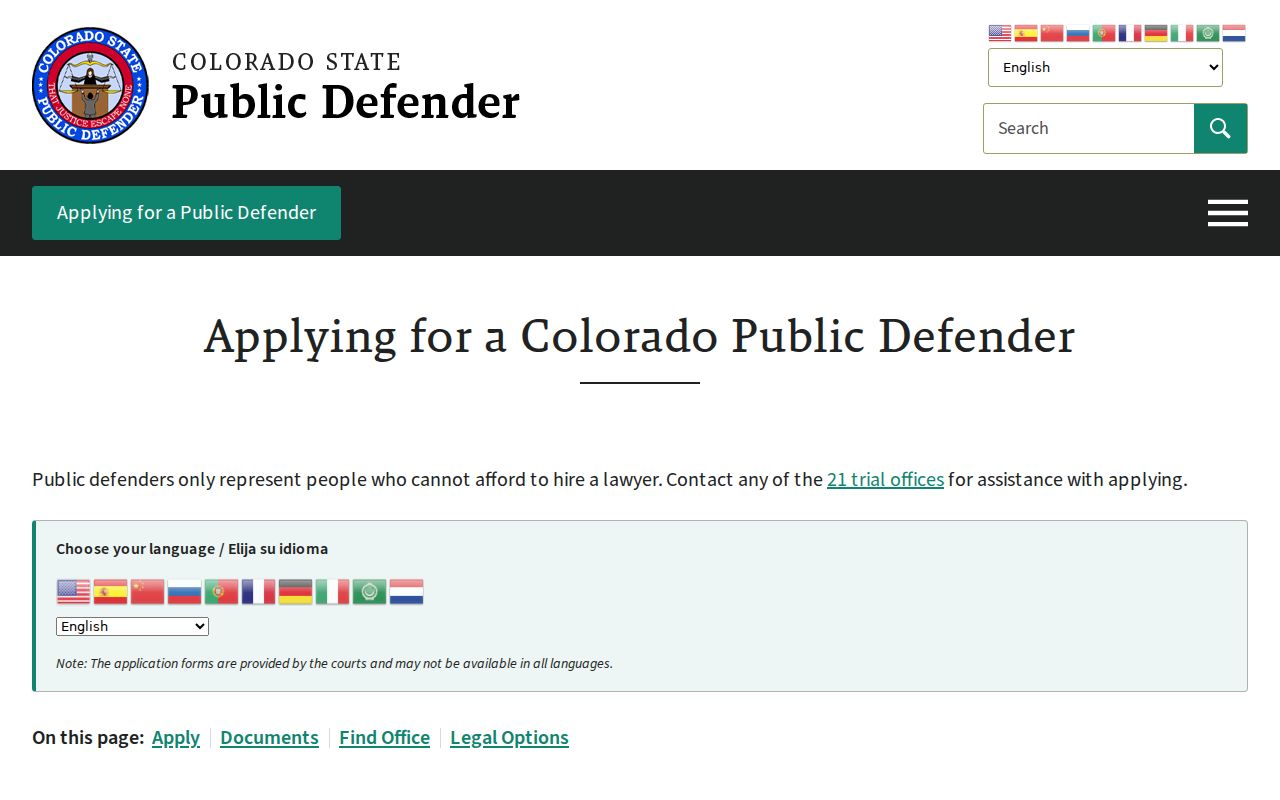
That application route is separate from record lookup, but it is relevant when arrest records have led to filed court charges.
Restricted Chaffee Arrest Records
Some Chaffee County arrest records and charge records are restricted. Juvenile arrests are excluded from public CBI ICHC results. Sealed or suppressed court cases are not ordinary public records. Law-enforcement reports may be withheld or redacted under criminal-justice records rules, and protected information such as victim data, minor names, medical details, financial identifiers, protected addresses, and Social Security numbers may be removed from public copies.
For law-enforcement records, the Sheriff's Records Division is the custodian path. For filed court charges, Chaffee Combined Court is the source. For statewide criminal history, CBI is the route. Mixing those sources can create errors, especially when an arrest did not lead to a filed charge or when a charge did not lead to conviction.